Deacons | diakonoi
Servant Leadership at Common Ground Church Wynberg
Introduction
It is not every day that we encounter the word "deacon" in our family of churches. However, this office is fundamental to the life of the early church. In the New Testament, deacons and elders are frequently mentioned together (cf. Phil 1:1; 1 Tim 3:1-12), underscoring the vital roles of both in a healthy congregation.
At Common Ground Church Wynberg, we want to model our leadership on these biblical principles. Our starting point must be a deep, theological understanding of the office, rather than simply reacting to the practical pressure of stretched teams. While deacons certainly help with practical needs, the office itself is a high spiritual calling.
What Does the Word "Deacon" Mean?
The word deacon (singular diakonos, plural diakonoi) is a masculine noun meaning servant, minister, or helper. The related verb diakoneo means to serve or to help. While the word implies service-oriented ministry, it is important to remember that words find their true meaning in context. In the New Testament—specifically in Romans 16:1, Philippians 1:1, and 1 Timothy 3:8-12—this word describes a formal office of service within the church.
What Do Deacons Do? To understand the function of a deacon, we look to Acts 6:1-3:
"Now in these days when the disciples were increasing in number, a complaint by the Hellenists arose against the Hebrews because their widows were being neglected in the daily distribution. And the twelve summoned the full number of the disciples and said, 'It is not right that we should give up preaching the word of God to serve tables. Therefore, brothers, pick out from among you seven men of good repute, full of the Spirit and of wisdom, whom we will appoint to this duty.'"
When the NIV uses the verb “to serve” in (Acts 6:2), it does so in relation to the apostles’ decision to devote themselves exclusively to prayer and the ministry of the word, rather than waiting on tables. Interestingly, this decision was made amid significant relational and ethnic tensions. Had the apostles’ wisdom failed at this stage, then “unity in diversity, and diversity in unity”, a hallmark of the early church, may have suffered a significant blow, and the church may have suffered a great setback.
We can see something else in this passage that points to the function of a deacon: Note the difference of function with that of an elder:
Elder - able to teach (1 Tim 3:2)
Deacon - “hold” to the profound truths of the faith (3:9)
An elder must be able to teach the faith; while a deacon must “hold” to the faith—this means he must understand the faith and be committed to the faith, but he doesn’t need to be able to teach it. But this doesn’t necessarily mean that those who can teach can’t be deacons; we see Stephen teaching effectively in Acts 7 and Philip in Acts 8. But ordinarily, a typical deacon’s gifting is not in the area of teaching.
Let’s look at another difference of function between an elder and a deacon from this list in 1 Tim 3:
Elder - must manage his own household well (3:4)
Deacon - essentially the same thing is said of a deacon in (3:12)
But notice there’s something added to the verse about the elder that isn’t added to the verse on the deacon:
So, what we’ve learned about the deacon’s role from this passage and Acts 6:
The deacon has a serving role, especially in mercy ministry
The deacon’s primary calling isn’t to teach
Historically, a deacon’s role has been in 3 broad categories with some overlap:
Administrative Assistance to Elders: Deacons partner with elders to handle specific ministry areas. For example, in a small group, an elder might handle teaching and shepherding, while a deacon cares for administrative and mercy concerns. In Acts 6, there was a particular need in the church because certain widows weren’t being properly cared for. The seven deacons were then assigned to take on this ministry of caring for God’s people.
Oversees Mercy Ministry: This is perhaps the most critical role. Deacons help those in material need, stepping in when families cannot provide sufficient support (1 Tim 5:3-8). One of the significant events during Paul’s 3rd missionary journey was the collection of money to help the poor in the Jerusalem church. Paul discusses this plan in (Rom 15:23-31) and (1 Corinthians 16:1-4), then devotes two chapters in 2 Corinthians to encouraging the Corinthians to follow through with the offering.
Promoters of Church Unity: In Acts 6, the apostles’ decision to appoint deacons saved the church from ethnic and relational division. By ensuring everyone is cared for, deacons protect the church’s "unity in diversity".
Two men on this list appear again in chapters 7 and 8: Stephen, who courageously defended his faith in Jesus before the Jewish leaders and was then stoned to death. Philip, who takes the gospel to the Ethiopian eunuch as he reads Isaiah 53 in his chariot, points him to Jesus in that passage. So, the task of serving widows, ensuring they were cared for, wasn’t given to just any man, but to godly, committed, and competent men. These men in Acts aren’t specifically called “deacons” in this passage, but there’s continuity or a connection between the role we see them playing in this passage and what we learn later in Scripture about the deacons.
Relief and Rehabilitation
Church leaders must be wise in discerning what kind of help is most effective.
Relief: This is for someone who cannot help themselves, like the man in the story of the Good Samaritan. It is the urgent, temporary provision of aid (food, money, accommodation) to alleviate immediate suffering caused by a crisis. At this stage, the church acts on their behalf.
Rehabilitation: This begins once the immediate crisis has stabilised. At this stage, the church works with them to find long-term solutions, such as securing new housing, sharing job contacts, or providing job training.
An example of this is the man in the story of the Good Samaritan, who was robbed, beaten, and left for dead. He couldn’t help himself. He needed relief. Someone defined relief as “urgent and temporary provision of emergency aid to reduce immediate suffering from a natural or man-made crisis.”
Someone who needs relief is someone whose shack has just burned down, whose shack was flooded, or who has just lost a job. Someone in this situation needs the church to act on their behalf, providing housing, food, and financial assistance. They need relief. However, not everyone needs relief; some require rehabilitation instead.
Once the bleeding stops and someone has reached the bottom and isn’t falling further, rehabilitation begins. When someone needs relief, the church provides support. When they need rehabilitation, the church works with them. You’re not really helping someone if you’re doing things for them when you should be doing things with them. In fact, you’re probably hurting them. So, what does rehabilitation look like for someone who’s in crisis and the bleeding stops?
Let’s use the example of someone whose shack was burnt down during the relief stage. You provide accommodation and food. In the rehabilitation stage, you work with them to find new housing and develop plans for their new dwelling.
For someone who has lost their job and is in the rehabilitation stage, you help them:
Form a prayer team to pray for them
Find another job
Share potential job contacts with them
You might also be able to point them to places where they can get job training to learn a new skill.
If they’re going to need to take a lower salary, help them work out how to live on it.
Treating someone in the rehabilitation stage as if they still need "relief" can actually harm them. Deacons need spiritual wisdom to help people move forward.
Relationship to Eldership Team
Deacons are not the "servants of elders," nor are they less important. They are servant-leaders with a different function. Sometimes, a deacon helping with a financial crisis may uncover a spiritual root, such as a gambling problem. In such cases, the deacon should bring an elder alongside them to address the spiritual heart of the matter while the deacon continues to assist with the practical crisis.
Qualities and Qualifications
According to 1 Timothy 3:8-12, deacons are not "super-Christians," but rather ordinary believers who demonstrate spiritual maturity. According to D.A. Carson, in terms of character, there is nothing expected of deacons or elders that is not also expected of every other Christian. He emphasises that there is not one set of character qualities for leaders and another for the rest of the congregation. Instead, deacons and elders are considered ordinary Christians who are growing in godliness and serve as positive models of Christlikeness.
Specifically, the text highlights that:
They are not perfect Christians.
They are not Christians of a different order or sphere within Christianity.
They are ordinary believers who possess a certain level of spiritual maturity.
The main difference between a deacon and an elder is not found in their character, but rather in their specific gifts and calling.
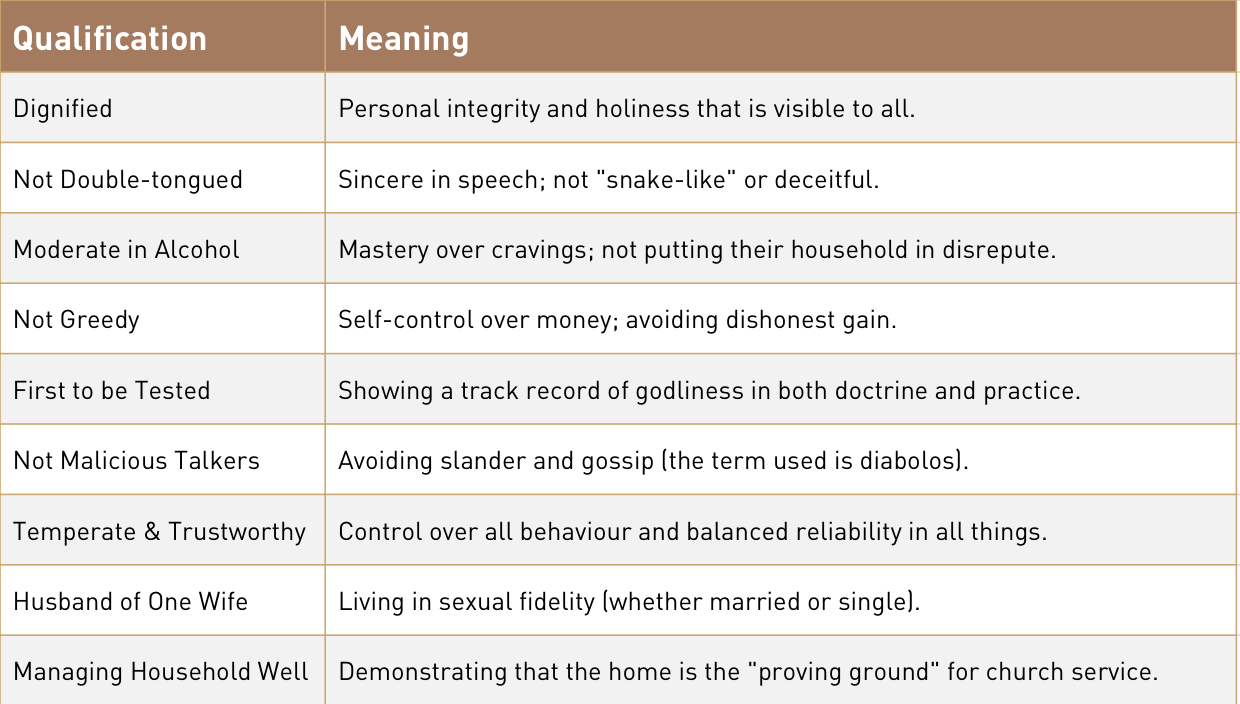
As G. W. Knight perceptively notes:
“To this positive trait are added three negative traits to be avoided. In all three, the quality of self-control is emphasised—with reference to speech, appetite for drink, and perspective on money, all of which the deacon must have under control rather than be controlled or betrayed by them.”
1 Tim 3:11 reads as follows: In the same way, their wives are to be women worthy of respect, not malicious talkers but temperate and trustworthy in everything. NIV
Women likewise must be serious, not slanderers, but temperate, faithful in all things. NRSV
As seen in the examples above, some versions treat the mention of deacons in 1 Tim 3:11 as referring to deacons' wives, while others prefer to include female deacons. This is because the word used for women and wives (gynē) can be used either way. If the text means ‘wives,’ there is a restriction on single women, which is inconsistent with Rom 16:1 above. However, if the text means women, then there is a balance to the contextual meaning, since there is no corresponding category of “elder’s wives” in the early parts of 1 Tim 3. 4.3 Furthermore, the role of deaconship is not exclusive to men based on our reading of 1 Tim 3:11; Phil 1:1; cf. Phil 4:2-3; Rom 16:1. For us, the word deacon, though a masculine noun, applies to both genders.
On this, Liefeld (1999, p.133), using Romans 16:1, comments:
“The unavailability of the feminine form of diakonos may provide us with the solution to the problem concerning Phoebe in Romans 16:1. While the verbal form means serve in general, the noun form in the New Testament usually indicates a position that is more than just servant. We cannot assume that since the form is masculine in 16:1 and since Phoebe was a woman, it cannot mean “deacon” there and must be translated “servant”. If the writer wanted to say she was a deacon, there was no other way to do it than to use the masculine form.”
Here are a couple of scriptures that support our view on female deacons:
I commend to you our sister Phoebe, a servant of the church at Cenchreae, that you may welcome her in the Lord in a way worthy of the saints, and help her in whatever she may need from you, for she has been a patron of many and of me as well. Romans 16:1-2 ESV
I entreat Euodia, and I entreat Syntyche to agree in the Lord.Yes, I ask you also, true companion, help these women, who have laboured side by side with me in the gospel together with Clement and the rest of my fellow workers, whose names are in the book of life. Philippians 4:2-3 ESV
The Appointment Process
Deacons should demonstrate spiritual maturity before their appointment. In Acts 6, even "waiting on tables" required men to be full of the Spirit and wisdom.
Potential deacons should ask themselves:
Am I regular at prayer meetings and community groups?
Am I proactive in serving?
Does the gospel direct my conscience?
Conclusion
Godly deacons are a great blessing to the local church. When administrative details are handled with care, the church is more harmonious and less prone to frustration and conflict. A church with active, engaged deacons feels like a family, a place where people want to commit themselves and invite their friends to encounter God's grace.
Deacon Training Reflection & Self-Assessment
Part 1: Spiritual Maturity & Character
Integrity: Do I strive for "360-degree transparency," being the same person in public as in private?
Speech: Am I "sincere" (not double-tongued), avoiding gossip and saying the same thing to everyone?
Self-Control: Do I demonstrate mastery over my appetites, particularly regarding alcohol and substances?
Financial Stewardship: Am I content with what I have, avoiding greed or dishonest gain?
Spiritual Rhythms: Am I consistently engaged in the life of the church through prayer meetings and community groups?
Part 2: The Heart of Service (Mercy Ministry)Doctrine vs Practice: Do I "hold" to the deep truths of the gospel with a clear conscience, even if I don't feel called to be a formal teacher?
Discerning Needs: Can I distinguish between a situation requiring "Relief" (urgent aid) and one requiring "Rehabilitation" (working with someone towards stability)?
Collaboration: Am I willing to work alongside Elders, identifying when a physical need might be rooted in a deeper spiritual issue?
Proactive Care: Am I looking for ways to serve spontaneously, or do I wait to be asked?
Part 3: Family and Household
Household Management: If I have a family, am I leading and managing my home with care and faithfulness?
Fidelity: Am I living a life of sexual purity and fidelity to my spouse (present, future, or absent)?
Part 4: Conclusion & Commitment
"The community should know those who display mature servant leadership, because it is a central hinge upon which the door of deacon appointment opens."
Being a deacon is a high calling. It is not a "stepping stone" to the eldership, but a unique and necessary role that brings harmony, peace, and family-like warmth to the local church.
Works Cited
George, W. Knight III. 1985. "Two Offices (Elders/Bishops and Deacons) and Two Orders of Elders (Preaching/Teaching Elders and Ruling Elders): A New Testament Study," Presbyterion.
Liefeld, Walter. 1999. “The Epistle to the Romans” NIVAC. Zondervan.
Works Consulted
Hoffmann, East. 2013. “Detroit Volunteer House: The Humble Beginnings of a Life-Long Urban Restoration Pursuit.”
Schaff, Philip. History of the Christian Church, Volume I: Apostolic Christianity. A.D. 1-100 - Christian Classics Ethereal Library.
Smethurst, Matt. 2021. “Deacons: How They Serve and Strengthen the Church:” 9 Marks
Article by Eric Mtimkulu, lead elder at Common Ground Church Wynberg